Leighton Street
The TommyknockersLeighton Street is the Utica street where Bobbi Anderson grew up and, more consequentially, the mental landscape she carries with her: a geography of family memory and constraint that Jim Gardener understands as an obstacle to her becoming the writer she wants to be. Gard’s poem “Leighton Street,” dedicated to Bobbi and read aloud in public, gives that private burden a form. The place matters not only as a point on a map but as a name for the past Bobbi is trying to leave behind and the sister whose presence still seems to sound in the night.
The Street and Its Inner Geography
Leighton Street is identified as the street in Utica where Bobbi grew up. Gard recalls that, in the year they met, it was all she could talk about. Her wish was to escape it and become a simple writer of simple stories, a capacity Gard believed she possessed with flash and ease. He also sensed that she might be capable of braver work, but first, in his understanding, she had to get away from Leighton Street—not simply the physical street, but the one she carried in her mind.
That inward version is populated by haunted tenements, a father who is sick and loved, a mother who is weak and loved, and a sister who defies the family and seems to dominate it. The description makes the street less a neutral setting than a compressed family history: the surroundings and the relationships have become inseparable. To leave Leighton Street, in this sense, means more than moving away. It means finding a way to write beyond the emotional world that continues to claim her attention.
Anne’s Hold and the Nighttime Memory
Gard’s recollection gives that history a particular, bodily consequence. Once, during Freshman Composition, Bobbi fell asleep in class. He had noticed the large circles beneath her eyes and held her for a moment after class. Still half asleep, she said she had trouble sleeping because she almost fell asleep and then heard her sister Anne. Anne’s teeth grinding became a sound Bobbi could not escape; she began to stammer over the noise before waking into hysterical weeping, which frightened Gard.
The memory clarifies why Gard thinks of Anne as more than one figure within Leighton Street’s mental geography: Anne is, in his formulation, more than anything else, Leighton Street. The street’s oppressive power is concentrated in the sister who intrudes into Bobbi’s attempts to rest. The recollection does not turn the actual Utica street into a supernatural place; rather, it shows how family pressure can persist as an inner landscape, returning through an ordinary nighttime sound and disrupting the boundary between sleep and waking.
The Poem and Its Dedication
Gard’s poem belongs to his first book, Grimoire. When he opens the battered copy at a reading at Northeastern, it falls to “Leighton Street,” and he finds its dedication: “For Bobbi, who first smelled sage in New York.” The poem was written in the year he met her, when Leighton Street occupied so much of her conversation. Its title carries the place into the book, while its dedication makes clear that this particular work is bound to Bobbi and to the memory Gard has of her.
He chooses to read the poem after joking that he will avoid reading new work and instead take the risk of performing a long poem from his first book. The choice is not presented as a neutral selection from an old collection: he winks toward Patricia McCardle before turning to the volume, and then reads “Leighton Street” for Bobbi. In Gard’s thoughts, the act is expressly for her. The poem thus joins the public reading to the private history it recalls, making the named street a point where their shared past enters the present.
A Place Made Public Through Reading
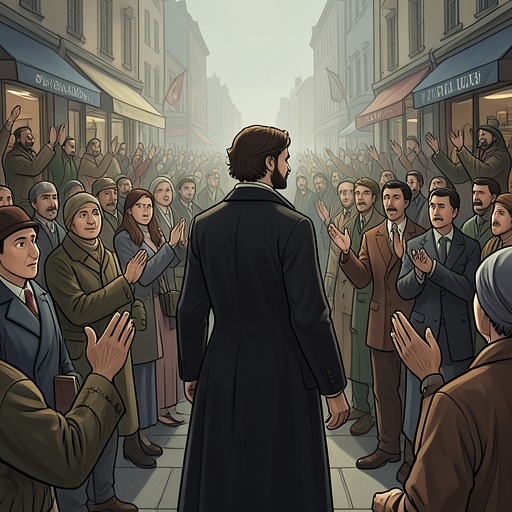
The reading takes nearly twenty minutes. Gard, who has not read the poem for so long that he rediscovers it as he goes, finishes in a deep silence. For a moment, he wonders whether he has read it at all or experienced it as a hallucination just before fainting. Then a young man stands and applauds, tears on his cheeks; the woman beside him rises too, also crying, and the audience follows in a standing ovation. The listeners appear dazed, as if awakened from a dream brighter than reality.
The response gives the poem’s private source a public afterlife: an audience with no stated connection to Bobbi is moved by Gard’s reading of the work shaped around her remembered street and family burden. Patricia McCardle, however, remains seated, stiff and straight, her hands clasped over her evening bag. Gard notices her closed, bloodless mouth with weary amusement. The contrast places the poem’s reception alongside the social contest surrounding the performance: the audience rises, while McCardle refuses to join it.
Significance in Gard’s Final Reading
The account identifies the performance as the last reading Jim Gardener will ever give in his life. That ending lends the poem’s return a particular finality: a work from his first book, written in the year he met Bobbi and dedicated to her, becomes the final poem he reads before an audience. The scene does not claim that Leighton Street resolves Bobbi’s history or releases her from Anne’s hold. Instead, it shows Gard using the poem to acknowledge that history and to make it audible to others.
Leighton Street consequently holds several meanings at once: a real childhood address, a remembered family world, and the title of a poem through which Gard addresses Bobbi in public. Its force comes from that overlap. The inner street is haunted by loved and troubling family figures, particularly Anne; the poem gives that haunting a shaped voice; and the audience’s silence, tears, and applause show how an intimate geography can become legible beyond the person who first carried it. For Gard, reading it is at once an act of devotion to Bobbi and the closing performance of his life.